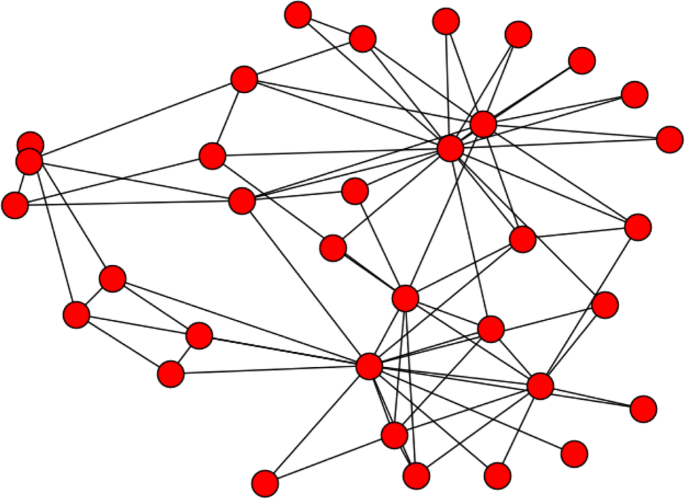
Introduction to Network Science: Basic definitions of networks, the role of networks and examples across different applications, topology control and network generation. Elements of graph theory and an overview of fundamental definitions.
Structure and characteristics of complex and social networks: random network models, small-world networks, power-law networks, scale-free networks, regular networks, random geometric graphs, etc.
Analysis of complex and social networks: analysis metrics (node degree distribution, clustering coefficient, network centrality, etc.), assortative mixing, and network creation/evolution.
Evolutionary computation: genetic algorithms, cognitive algorithms, parallel computation, and heuristic computational methods.
Applications in Telecommunications and Computer Science: topology control, routing and resource allocation, the impact of network structure on information diffusion/opinion formation, the influence of social networks on recommendation systems, information epidemiological models, cooperation and synchronization, and the impact of social networks on advertising systems.
Laboratory component: emphasis is placed on the collection of free/open data from social networks, data processing and statistical analysis, aiming at the study of network topologies and characteristics,
- Teacher: Συμεών Παπαβασιλείου
ECTS : 5
Study Load : theory 2, lab 1
Language : el
Learning Outcomes : This course presents the theory and computational tools for the analysis of social networks and information networks. The syllabus aims to provide an understanding of the science of complex networks (Network Science). Students will become familiar with the basic elements of graph theory, the structure and characteristics of complex and social networks, as well as methods and metrics for the analysis of complex and social networks. Finally, the course aims to familiarize students, through laboratory exercises, with the collection of open data from social networks, data processing, and statistical analysis, with the goal of studying network topologies and characteristics, identifying influential nodes, detecting communities, and analyzing information diffusion and opinion formation.
Upon successful completion of the course, students will be able to:
• understand the characteristics, functions, and structure of complex and social networks;
• understand metrics for the analysis and evaluation of social networks;
• use tools for social network and data analysis;
comprehend the operation of basic social networking services;
• specify requirements related to user communication and interactions using social networking technologies.